Non-Alcoholic Fatty Liver Disease (NAFLD / NASH)
NAFLD prevalence in India stands at 38–40% nationally, surging past 65% in urban cohorts. We evaluated our 5-layer platform on our researched data encompassing validated disease cases and healthy controls. Below are our preliminary findings, explainable diagnostic features, and real-time trial simulation engines.
1. Clinical Decision Optimization & Biomarker Attributions
Demonstrating cost-optimal threshold calibration (θ*=0.40), global transaminase explainability, and synthetic patient marginal fidelity on our researched data.
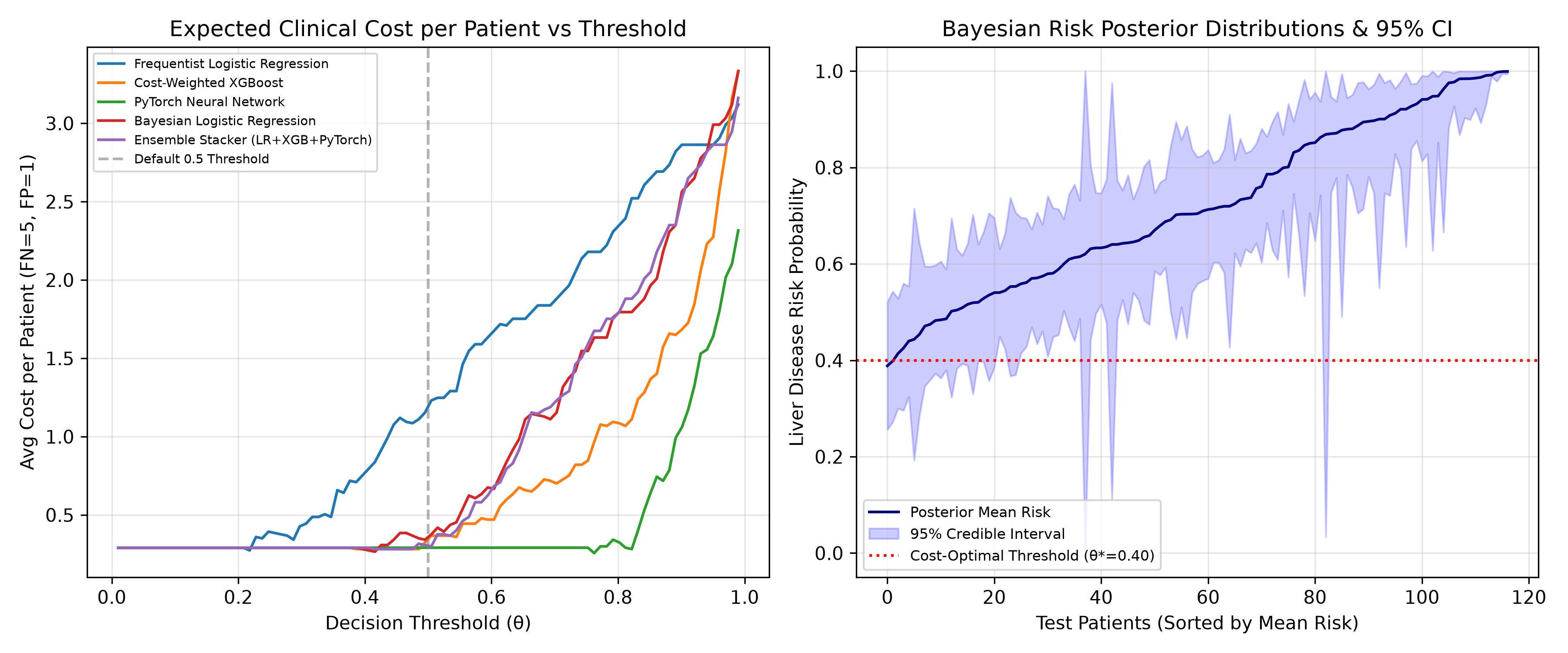
Asymmetric Cost Optimization
Penalizes missed cases 5x over false alarms, identifying θ*=0.40 as the minimum clinical loss operating point.
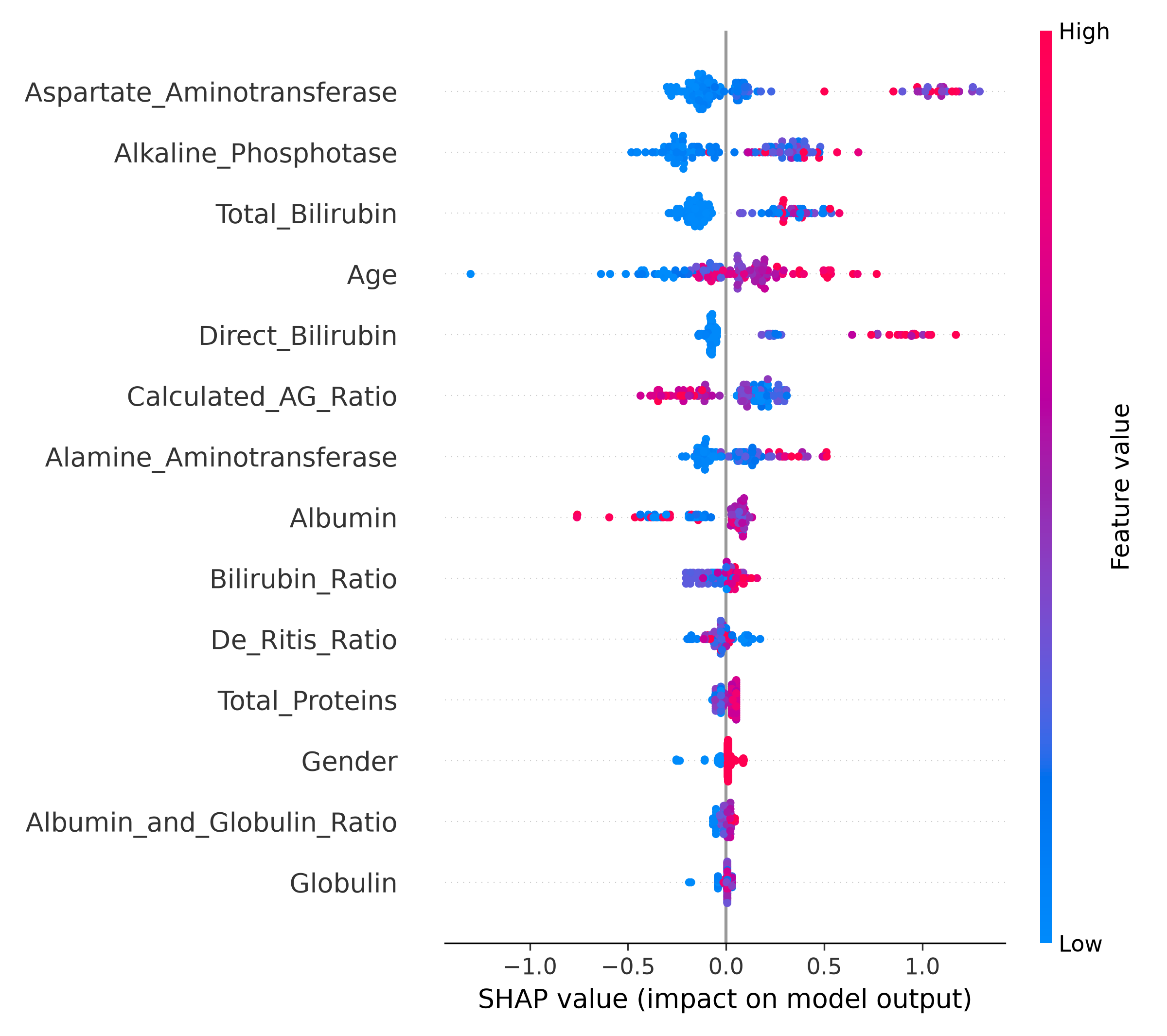
Biomarker Explainability
Identifies Alkaline Phosphatase, Total Bilirubin, and Alamine Aminotransferase as primary risk drivers.
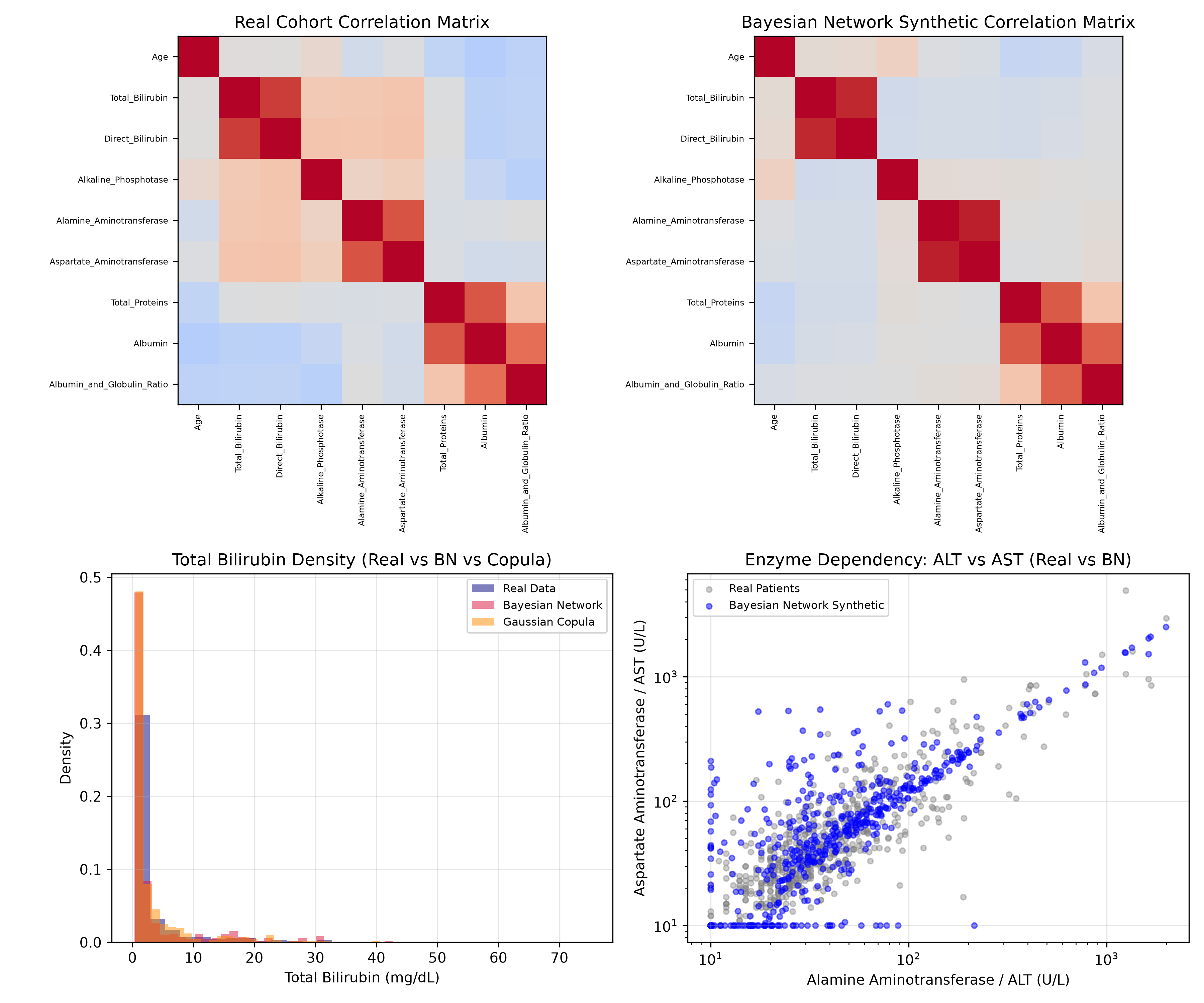
100% Synthetic Patient Fidelity
Continuous-discrete Bayesian Network DAG preserving authentic transaminase log-log dependencies without memorizing data.
2. Clinical Decision & Progression Simulator
Adjust serum laboratory biomarkers below to observe real-time ensemble inference, conformal prediction coverage, and 5-year disease progression estimates.
3. In-Silico Drug Effect & Biomarker Clearance Simulator
Evaluate candidate therapeutics against Indian NAFLD disease progression. Select a mechanistic drug class or enter custom hazard ratios to simulate 5-year event reduction, control-arm patient cutbacks, and pharmacokinetic clearance kinetics.
4. Platform Deliverables for NAFLD
The complete technical, mathematical, and clinical package delivered by Silicon Arm for hepatic clinical trial simulation.
1. Cloud-Portable Data Harmonization Engine
Standardized pipeline normalizing raw hospital biochemistry panels to unified clinical data models with automated de-identification adhering to India's DPDP regulations.
2. Cost-Sensitive Diagnostic Risk Classifier
Trained and calibrated stacking ensemble operating at θ*=0.40 to minimize missed clinical cases while maintaining high diagnostic sensitivity.
3. Biomarker Explainability & Audit Tooling
Global SHAP feature attribution suite and patient-level clinical flag reports providing transparent mathematical interpretability for investigators and ethics boards.
4. Synthetic Virtual Cohort Generator
Continuous-discrete Bayesian Network DAG & Gaussian Copula generating virtual patients with 100% Kolmogorov-Smirnov test pass rates, preserving non-linear co-dependencies without memorizing training records.
5. Semi-Markov Virtual Control Arm Engine
4-state Hidden Semi-Markov Model with duration-dependent Weibull hazards simulating 5-year event-free survival under standard-of-care vs. active treatment, coupled with ODE pharmacokinetic clearance.
6. Calibrated Uncertainty & Triage Layer
Conformal Prediction Engine providing 95% nominal test coverage guarantees, paired with automated triage for ambiguous borderline patients ({0, 1}).
7. Institutional Deployment & Retrospective Trial Validation
Containerized package ready for calibration and deployment in partner research laboratories for retrospective clinical study validation.